
Everything you need to evaluate, price, and deploy AI customer service chatbots — including real ROI math, implementation steps, integrations, and failure modes to avoid.
Who this is for + key takeaways
- Buy for outcomes: faster first response, higher self-serve resolution, lower cost per ticket.
- Win on implementation: source-grounded answers, clean handoffs, analytics, and governance.
- Target a 3–10x ROI in 3–6 months; start narrow, iterate weekly.
When an AI CS chatbot makes sense (and when it doesn’t)
Good fits:
- Top 30–80 FAQs with clear policies or steps.
- Order status, account updates, subscription changes.
- Internal IT/HR help desks with structured SOPs.
Poor fits:
- Ambiguous, emotionally charged issues without policy guidance.
- Sparse or outdated knowledge; no escalation path.
Pricing models and ranges
Budget across platform fees, usage, implementation, and ongoing optimization.
1) Platform-only (SaaS): $200–$1,500/month for licensing; usage billed per message or token. Pros: fast start. Cons: limited customization/handoffs.
2) Done-for-you setup: $3,000–$15,000 implementation (2–4 integrations, 30–60 intents). Retainers $500–$2,500/month for QA, analytics, and updates.
3) Custom builds: $20,000–$150,000+ depending on traffic, security, and workflows. Opex includes model usage, monitoring, and infra.
ROI framework and calculator
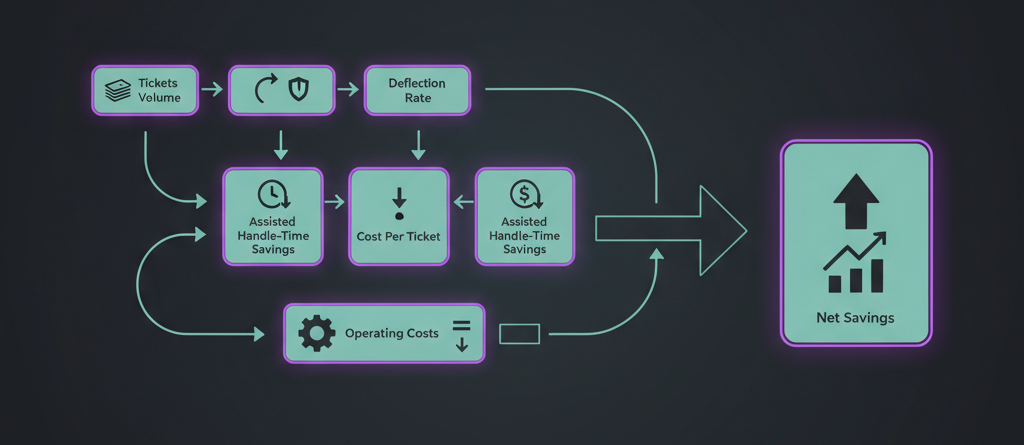
Inputs: Monthly tickets (M), deflection rate (D%), avg. cost per ticket (C); handle-time saved on assisted tickets (A minutes) and share (S%); overtime/weekend coverage savings (O).
Formula: Savings ≈ (M × D × C) + (M × (1−D) × S × A × hourly_rate/60) + O − (platform + usage + maintenance)
Worked example:
- M=8,000; D=30%; C=$4; S=40%; A=3 min; hourly_rate=$25; O=$1,500
- Savings ≈ (8000×0.3×4) + (8000×0.7×0.4×3×25/60) + 1500 − costs
- ≈ $9,600 + $2,800 + $1,500 − costs
With $1,200 platform + $600 usage + $800 maintenance = $2,600, net ≈ $11,300/month. Payback under 6 weeks.
Implementation step-by-step
- Define scope: top 30 intents, escalation policy, success metrics.
- Knowledge prep: consolidate FAQs/SOPs; add citations per answer.
- Guardrails: refusals, tone, compliance filters, PII handling.
- Handoff design: triggers, transcripts, tags, priority, and SLAs.
- Integrations: Zendesk/Freshdesk, HubSpot/Salesforce, Confluence/Notion/Drive.
- Analytics: deflection, CSAT, fallbacks, cohort trends, content gaps.
- Pilot: 4–6 weeks with weekly QA and content updates.
Key integrations
- Helpdesk: Zendesk, Freshdesk — tickets, macros, tags, and handoffs.
- CRM: HubSpot, Salesforce — identity, segmentation, lifecycle stage.
- Knowledge: Confluence, Notion, Google Drive — source-grounded answers.
- Messaging: Slack, Teams — internal support and approvals.
- Analytics: dashboards, QA tools, alerting.
Governance, security, and compliance
- Access control, audit logs, redaction, regional data residency.
- PII handling, retention policies, DPIAs (where required).
- Human-in-the-loop on sensitive intents and refunds.
Mini case studies
- SaaS onboarding: 32% deflection in 10 weeks, +8pt CSAT on first response.
- Retail order status: 41% deflection; AHT −2m; $14k/month saved.
- Internal IT: 28% faster resolution; weekend coverage without extra headcount.
Common failure modes (and quick fixes)
- Uncited answers → require source citations and link previews.
- Stale knowledge → weekly content ops and owners per policy.
- No handoff → explicit triggers, transcripts, routing, and SLAs.
- Weak analytics → instrument deflection, fallbacks, cohorts, QA tags.
Templates, checklist, and next steps
- Implementation checklist: scope, intents, guardrails, handoffs, analytics.
- ROI calculator: editable inputs for your volumes and rates.
- QA rubric: weekly review template with action owners.

Alex Carter
AI Strategist